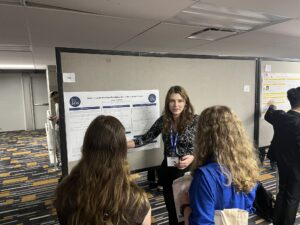
Two UMW mathematics students, Juniper Creskoff (Math ’27) and Ashton Crawford (Math ’28), recently presented their research at the Mathematical Association of America’s 2026 Mathfest in Boston, MA. Both students were led by Professor of Mathematics Dr. Randall Helmstutler. Juniper presented the project “Determining the Maximum Probability Gain in the Birthday Problem.” Ashton’s project was titled “Splitting the Bill: An Extension of the Dining Cryptographers Problem.”
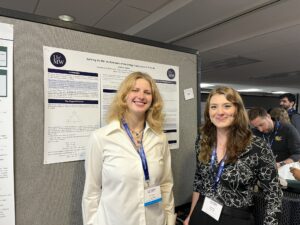
Juniper’s project focused on the a phenomenon known as “the birthday problem.” When there are 23 people in a group, there is already a 50% chance that two people will have the same birthday (day and month, not including year). When the group size increases to 57 people, this jumps up to a staggering 99% chance of a birthday match. These surprisingly high probabilities make up the birthday problem. This is important because of its implications in cryptography. Collision attacks work to decrypt information by finding a match between two things. The high probabilities in the birthday problem indicate a high probability of a collision attack working, and your encrypted information not being secure. Discrete methods were utilized to create a function that represents the probabilities in the birthday problem. Letting the number of birthdays in a year become a variable instead of a fixed constant allowed for more abstraction. A gain function was defined as the difference in probabilities as you add one more person to the group. The project focused on properties of these gain functions including their interesting shape—particularly the fact that they each possess one unique maximum which sometimes occurred at two consecutive locations. The maximum was located using discrete methods and single point estimates were derived using both discrete mathematics and calculus. The gain functions are an unknown discrete probability distribution, meaning that it has all positive values, and every point added together sums to one. Further research is required to determine more information about the distribution such as its expected value (mean). Juniper presented this research at the Irene Piscopo Rodgers ’59 Summer Science Insitute Symposium in the summer of 2025, at another conference associated with the Mathematical Association of America hosted at UMW in the fall 2025, and the MAA’s MathFest in Boston in August 2026. At MathFest, it won an outstanding poster award.
I love the fact that undergraduate research is encouraged at conferences with mathematicians that have decades of experience. It shows how, at the undergraduate level, research can be more important that you may realize.
–Juniper Creskoff (Math ’27)
Ashton’s project takes the Dining Cryptographers Problem, a well-known cryptography problem from the early 1980s, and generalizes it to function in a broader range of situations. The solution to the original problem lets members of a trusted group know if one of them has possession of a key without letting everyone know precisely who has the key. The original problem does a great job at exactly that, knowing if someone has the key while maintaining the anonymity of the keyholder, but it only allows for one key to be in play at any moment. As soon as there are two keyholders involved, everything breaks. The project focused on developing a solution to allow for up to two keys to be in play while still maintaining the anonymity of the keyholders. To allow for two keyholders, the algebraic structure of the original problem was altered to allow for more possible outcomes. This new structure allows one or two keyholders, so it does in fact extend from the original scheme. However, with this increase in possibilities come some limitations. In the original solution, only three people were required for everything to function correctly. In the new solution, at least five people are needed to successfully run the protocol. Future research may consider the algebraic modifications needed to allow for more than two keyholders. Ashton presented her research at the Irene Piscopo Rodgers ’59 Summer Science Institute Symposium in July 2025 and at MAA’s MathFest in Boston in August 2026, winning an award for outstanding poster.
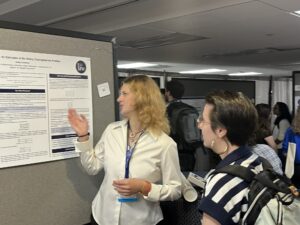
SSI providing me the opportunity to research and present on a topic I find so interesting has been so incredible, and completely shifted my goals for the future. I feel so lucky to be able to do this while still so early into my post-secondary career. –Ashton Crawford (Math ’28)
Leave a Reply