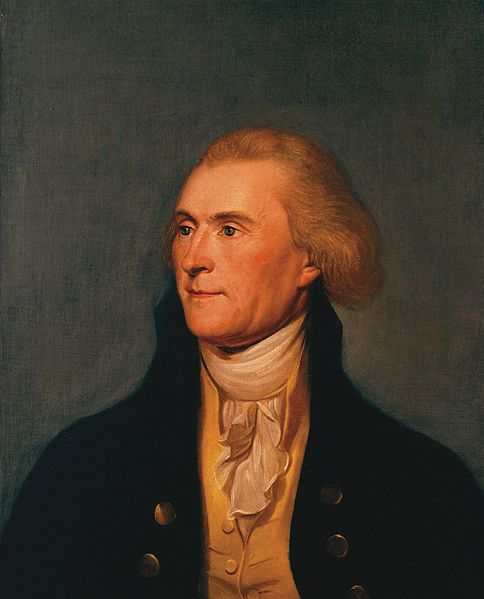
In January of 1777, in Fredericksburg, Virginia, Thomas Jefferson met with a small group to draft what would become the Bill to Establish Religious Freedom in Virginia. The Bill was enacted into law by the Virginia General Assembly in 1786. The Statute for Religious Freedom established the legal right to complete freedom of worship in the Commonwealth of Virginia and was a significant step leading to the first amendment to the U.S. Constitution, which also guarantees religious freedom. The Statute for Religious Freedom was one of the three works for which Jefferson himself wished to be remembered as he wrote in his own epitaph, “Author of the Declaration of American Independence/ Of the Statute of Virginia for religious freedom /and Father of the University of Virginia.”
Since 2002, the 225th anniversary of the writing of this work, the Department of Classics, Philosophy, and Religion has sponsored the annual Jefferson Lecture on Religious Freedom here at the University of Mary Washington. The lecture brings to our campus and community a wide range of public figures and distinguished scholars to discuss the nature and importance of religious freedom and the legacy of Jefferson’s ideas.
2017 Jefferson Lecture
Celebrating the Statute of Religious Freedom
Sponsored By The UMW Department of Classics, Philosophy, & Religion
Free and Open to the Public
Professor M. Andrew Holowchak, who has eight books/anthologies on Thomas Jefferson since 2012 and who has been called ‘the world’s foremost expert in Jefferson’s philosophical thought,’” will deliver this year’s lecture, entitled “Jefferson and Jesus.”
Dodd Auditorium, George Washington Hall, University of Mary Washington
♦ Thursday, January 26, 2017, at 7:30 PM
♦ For more information, call (540) 654-1342
*The quote is from American Studies scholar Ari Helo: “This [forthcoming book] is yet another genuinely remarkable achievement in the field of Jefferson studies offered by Doctor Holowchak, who has fast established himself as the world’s foremost expert in Jefferson’s philosophical thought.”
Previous Jefferson Lectures:
2002: Nadine Strossen, President, the American Civil Liberties Union
2004: Barry Lynn, Executive Director, Americans United for Separation of Church and State
2006: William Schulz, Executive Director Amnesty International America
2007: Seyyed Hossein Nasr, University Professor of Islamic Studies at The George Washington University
2008: Martin Marty, Fairfax M. Cone Distinguished Service Professor Emeritus of the History of Modern Christianity and on the History of Culture, University of Chicago
2010: Robert Pennock, Professor of History and Philosophy of Science, Michigan State University
2011: Martin Marty and Seyyed Hossein Nasr: A Christian-Muslim Dialogue
2012: Professor John Fea, Department of History, Messiah College: “Was America Founded as a Christian Nation?”
2013: David Holmes, Walter G. Mason Professor Emeritus of Religious Studies College of William & Mary: “Nothing Miraculous, All Things Ethical: A President and His Bible”
2014: Dr. Amina Wadud, emeritus professor of Islamic Studies at Virginia Commonwealth University: “Whose Freedom? Islam, Gender, and the Politics of Representation”
2015: Douglas Laycock, Robert E. Scott Distinguished Professor of Law, Class of 1963 Research Professor in Honor of Graham C. Lilly and Peter W. Low Professor of Religious Studies: “Religious Freedom and the Culture Wars”
♦ ♦ ♦ ♦ ♦ ♦ ♦ ♦ ♦ ♦
From The Autobiography of Thomas Jefferson 1743-1790
(University of Pennsylvania Press, 2005. pp. 67-71)
“Early therefore in the session of 76 to which I returned, I moved and presented a bill for the revision of the laws; which was passed on
the 24th of October, and on the 5th of November Mr. Pendleton, Mr. Wythe, George Mason, Thomas L. Lee and myself were appointed a
committee to execute the work. We agreed to meet at Fredericksburg to settle the plan of operation and to distribute the work. We met there accordingly on the 13th of January 1777. The first question was whether we should propose to abolish the whole existing system of laws, and prepare a new and complete Institute, or preserve the general system, and only modify it to the present state of things.…. This last was the opinion of Mr.Wythe, Mr. Mason & myself. When we proceeded to the distribution of the work, Mr. Mason excused himself as, being no lawyer, he felt himself unqualified for the work, and he resigned soon after. Mr. Lee excused himself on the same ground, and died indeed in a short time. The other two gentlemen therefore and myself divided the work among us…
The bill for establishing religious freedom, the principles of which had, to a certain degree, been enacted before, I had drawn in all the latitude of reason & right. It still met with opposition; but with some mutilations in the preamble, it was finally passed; and a singular proposition proved that it’s (sic) protection of opinion was meant to be universal. Where the preamble declares that coercion is a departure from the plan of the holy author of our religion, an amendment was proposed, by inserting the word “Jesus Christ,” so that it should read “a departure from the plan of Jesus Christ, the holy author of our religion” the insertion was rejected by a great majority, in proof that they meant to comprehend, within the mantle of it’s (sic) protection, the Jew and the Gentile, the Christian and Mahometan, the Hindoo, and infidel of every denomination.”