New and Updated Courses




DGST 301N: AI In Society
COMM 378: Health Communication
DGST 301Q: Intro to Podcast Production
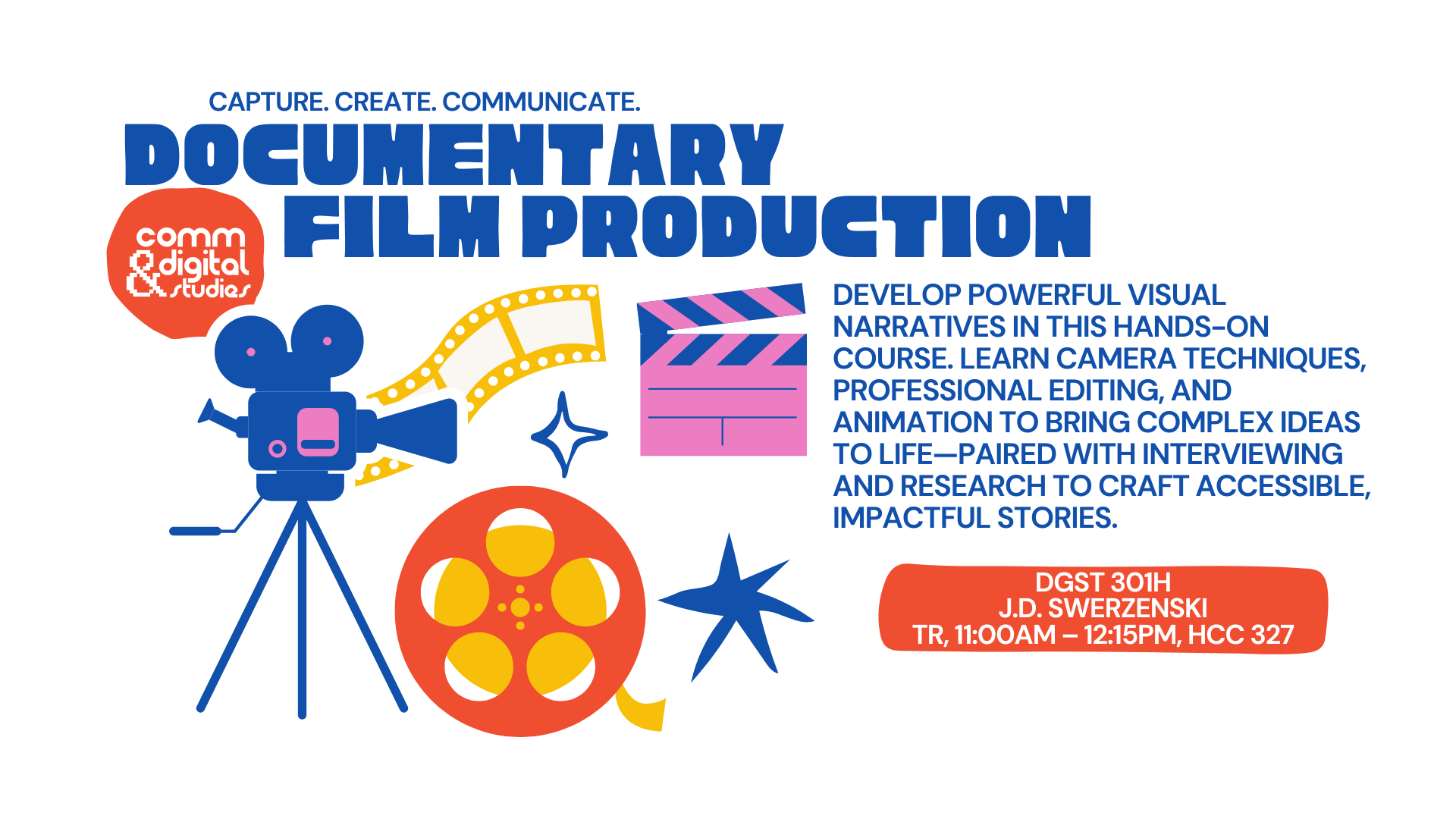
DGST 301H: Documentary Film Production
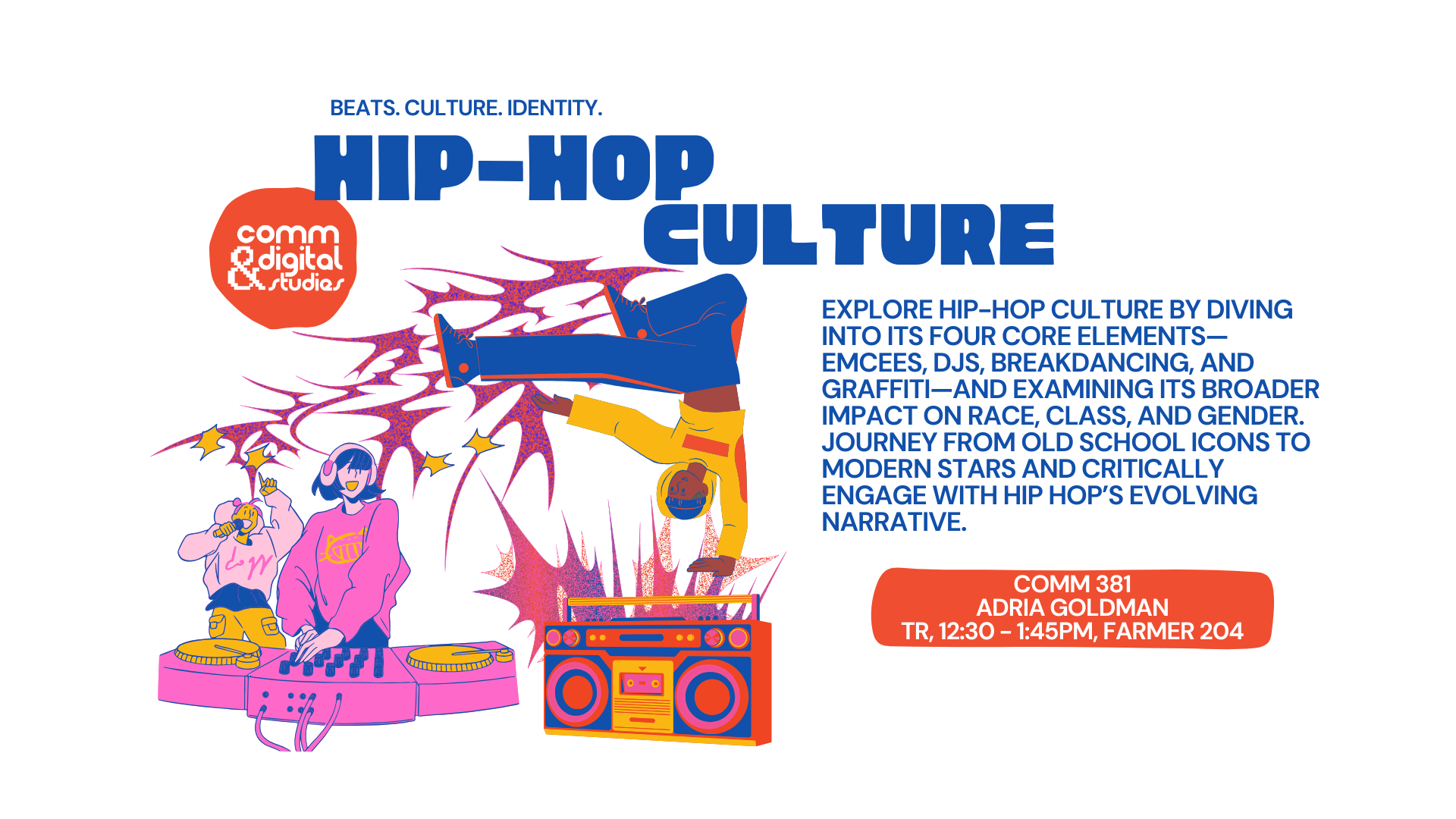
COMM 381: Hip-Hop Culture
JOUR 301: Magazine Journalism
DGST 302: Creative Coding
JOUR 380: Practicum Journalism
Communication
COMM 205– Public Speaking
Study of the basic principles of public address. Emphasis is on developing a theoretical and practical understanding of oral communication through practice in preparing, delivering, and criticizing speeches in class.
COMM 206– Small Group Communication
Study of the theories and principles of effective communication and decision making in small group contexts. Emphasis is on understanding communication capabilities as a participant in and leader of small groups.
COMM 209– Argumentation
Study of the use of reasoning in persuasive communication with emphasis on the construction, evaluation, presentation, refutation, and defense of oral arguments.
COMM 340– Introduction to Rhetoric and Communication
Introduction to human communication studies, focusing on the history, theory, criticism and mediation of persuasive messages to discover their roles in human society, culture, and contemporary life.
COMM 341– Communication Research Methods
This course introduces students to the study of the qualitative, quantitative, and rhetorical methods used to conduct communication research. Topics covered include research design, data collection, data analysis, and a review of the major sources for publication of academic and professional research in communication. Students will complete a communication research project and present their results.
COMM 353– Visual Rhetoric
Study of the rhetoricaluse of visual texts with an emphasis on the development and use of visual arguments.
COMM 357: Social Media
Study of the communication theory and practice of social media as used by individuals and groups.
COMM 370AA: Environmental Communication
How does communication contribute to more just world-making? In this course, we will examine communication by a range of environmental stakeholders, including industry spokespersons, government officials, NGOs, scientists, Indigenous groups, journalists, researchers, and interested citizens, to better understand how “the environment” is described, defined, negotiated, silenced, and transformed across complex spatial and temporal scales. Opportunities for engaged field research, multi-media learning, and active knowledge collaboration help illustrate some of the many ways the environment intersects with politics, culture, economics, technology, society, and more.
COMM 375– Not-For-Profit Communication Campaigns
This course takes a broad view of not for profit communication campaigns, including, but not limited to health, human rights, and environmental campaigns. Topics include theoretical foundations, design, evaluation, and the new media environment, all while using applicable examples and readings. Students will have the opportunity to design a digital communication campaign.
COMM 376– Gender and Communication
Explores the ways in which communication constructs gender. This course will be a guided study of the different areas in which our understanding and expectations of gender emerge. Covers theoretical foundations and approaches to gender and communication, and areas such as family, workplace, media, and politics
COMM 377– Pop Culture
This course uses theory and research to explore the complexities of pop culture (examples: music, film, social media, fads, slang, toys), including its creation and impact on society. Special emphasis is placed on the impact of pop culture on identity, the role of intersectionality, and the impact of digital media.
COMM 378– Health Communication
Introduces major concepts and areas within health communication, including: interpersonal, such as provider-patient and caregiver-patient; cultural and social components of how we understand and communicate about health; media and health, including entertainment programming, advertising, digital communication, and media effects; and public health, including policy reform and health promotion.
COMM 379– Professional Communication
The course will allow students to explore, develop, and analyze effective job materials, digital networking opportunities, and interview strategies, in order to generate a personalized professional plan for beyond the UMW classroom. Students will study professional communication, organization communication, and public relations research and methods through speaking intensive assignments, pop culture analysis, and a public relations campaign of their design.
COMM 460– Seminar in Digital Rhetoric
Prerequisites: COMM 340 or permission of the instructor. Study of the contemporary function of rhetoric in the context of our globally networked society.
Digital Studies
DGST 101– Introduction to Digital Studies(3 Credits)
Introduces an interdisciplinary approach to using technology and specifically provides a foundation for the Digital Studies Minor. Coursework may include digital approaches to creavity, historiography, media analysis and thinking critically about and through digital culture.
DGST 106– Digital Storytelling(3 Credits)
Students explore how technology has changed the way we publish and disseminate narratives including the roles of digital text, audio, video, and images in narrative. Students use technology including blogs, virtual worlds, and computer games to create and tell their own stories. Cross-listed as CPSC 106.
DGST 201– Tinkering, Hacking, and Making(3 Credits)
This course introduces students to the process of making, from initial design to the finished product, and to the emerging maker culture. Students are introduced to a variety of tools and practices for the development and making of objects using innovative software and hardware.
DGST 301M– Media Production for Social Change
This service learning-based course will involve working directly with community organizations
to develop original social media campaigns, graphic designs, and video projects. Beyond
building production skills in Adobe Photoshop and Premiere, our goal will be to effectively
translate the core values and messages of community partners through the multimedia works
we create.
DGST 302– Creative Coding
Introduces students to programming for creative purposes including computer-generated literature, art and animation.
DGST 303– Digital Media Studio
This course introduces basic elements of video production and streaming. Students apply these techniques to plan, write, and produce a live video show streamed weekly on the open web.
DGST 305– Introduction to Video Production
What is the visual language behind the film, television, and online video works we view
everyday? We’ll learn to speak this language, understand its rules, and get comfortable
expressing ourselves through it with our own video projects.
DGST 395– Applied Digital Studies
Apply the skills and methodologies developed in the Digital Studies curriculum toward larger-scale, self-designed digital projects that contribute meaningfully to some cultural field, academic discipline, social issue, or other research question.
Journalism
JOUR 200– News Journalism
An introduction to the techniques of newsgathering, including practice in news judgement, interviewing, and writing various kinds of news stories.
JOUR 300– Investigative Journalism
Practice using more advanced reporting techniques, such as using public documents and analyzing data to tell news stories.
JOUR 301– Magazine Journalism
Practice reporting and writing longform magazine stories incorporating multimedia for online audiences.
JOUR 380– Practicum in Journalism
Practice writing, taking photos, editing stories and other activities for the University of Mary Washington’s student newspaper, an experience that will help students learn the principles of sound journalism and how news helps to form community. May be repeated for a total of eight credits.